
Earth & Freud
Or, two new book reviews.
As my life calms down a bit after redundancy, a new day-job, moving house and the delights of the Winter Solstice, I find myself reading in my lunch break at the day-job again. Rather than reprint some old tat from my blog, here today are reviews of the most recent two books I’ve read, one of which has much relevance to our exploration of the human condition…
In Becoming Earth: How Our Planet Came To Life, science author and journalist Ferris Jabr puts together a very enjoyable book in which the inextricable worlds of planet and life – rock, water and air, and the biosphere – are explored. This is a book in which James Lovelock’s Gaia Theory is celebrated as Earth Systems Science and given the full treatment: well written, fascinating, eye-opening.
The book is split into three sections, each subdivided into three chapters. Rock covers deep-planet microbes (a truly extraordinary opening chapter), how large animals change landscapes, and the relationship between plants and soil. Water covers the critical functions of plankton, without which Earth would be very different, marine vegetation such as seaweed and kelp, and plastic pollution. Air covers microbes, weather and rainfall, then fire, then a final chapter on the basics of reducing carbon dumping into the atmosphere.
Each chapter is solidly based in science. The latest developments up to 2024 are here. The focus of the book as a whole is on the deeper time view, with the author pointing out that our planet has quite happily existed in many different forms. If we go extinct, like the other animals we’re currently exterminating, the planet will get hotter but thermophiles will enjoy it. For sheer common sense, clarity of explanation and strength of vision, this is a hard book to beat. A fascinating epilogue on Lovelock’s changing concepts of Gaia makes for enlightening reading. Highly recommended!
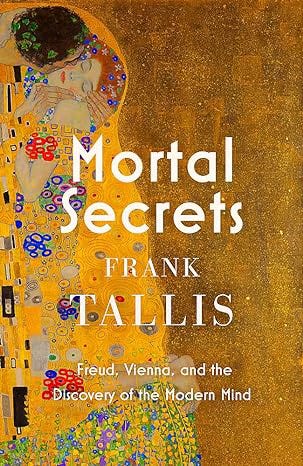
The book I’ve just finished is Mortal Secrets by Frank Tallis, subtitled: Freud, Vienna and the Discovery of the Modern Mind. I spotted this in Waterstones last year, recognising the author’s name because Nicci and I were huge fans of the Vienna Blood television series, in which two mismatched detectives, one a proto-Freudian, investigate murder mysteries – best of recent tv, if you haven’t seen it.
This book is in essence a survey of Freud’s life and psychoanalytic hypotheses, focusing on their relevance to us in our modern age, but it touches on the social and cultural life of the Viennese around the turn of the century and up to World War 2 as well. The author makes conspicuous and worthy attempts to be fair to Freud, whom, he observes, only has disciples and enemies – nothing in between. Myself, I probably would be somewhere in the middle. I think Freud’s grasp of the role and sheer size of the unconscious mind is one of the most significant of psychological discoveries. Then again, the castration complex is bollocks and penis envy is a load of cock.
The book follows a roughly chronological timeline, with diversions here and there into the hierarchy-conscious Viennese, their love of coffee in coffee-houses, and the politics of the time, especially that relating to Jewish culture. Freud, after all, had to flee the Nazis in 1938. There is a lot to like in this well-written and engaging book. I found it a bit Freud-heavy and a bit Vienna-light, but it was a good read, enlightening, with the author’s desire to be even-handed evident throughout. There is even an unexpected chapter concerning itself with Friston and the free energy principle, entropy and self-organising systems, homeostatic stability and the effects of the Second Law of Thermodynamics. Elsewhere, the author dissects Freud’s most famous cases. In the case of the Wolf Man – perhaps Freud’s most notorious venture – he is particularly scrupulous about being fair and transparent, showing where Freud was clearly wrong.
What comes across best in this book about Freud’s life and times is how much people back then believed human beings are animals with a veneer of social respectability and restraint, instead of what many people believe these days which is the reverse: that we are social beings above all, with a bit of instinct whirring away underneath. Overall, a very good read, and pretty thought-provoking.
Another enjoyable and informative column. I just reserved Jabr's book as I think I would find it fascinating, too. Thank you for bothering to write these.