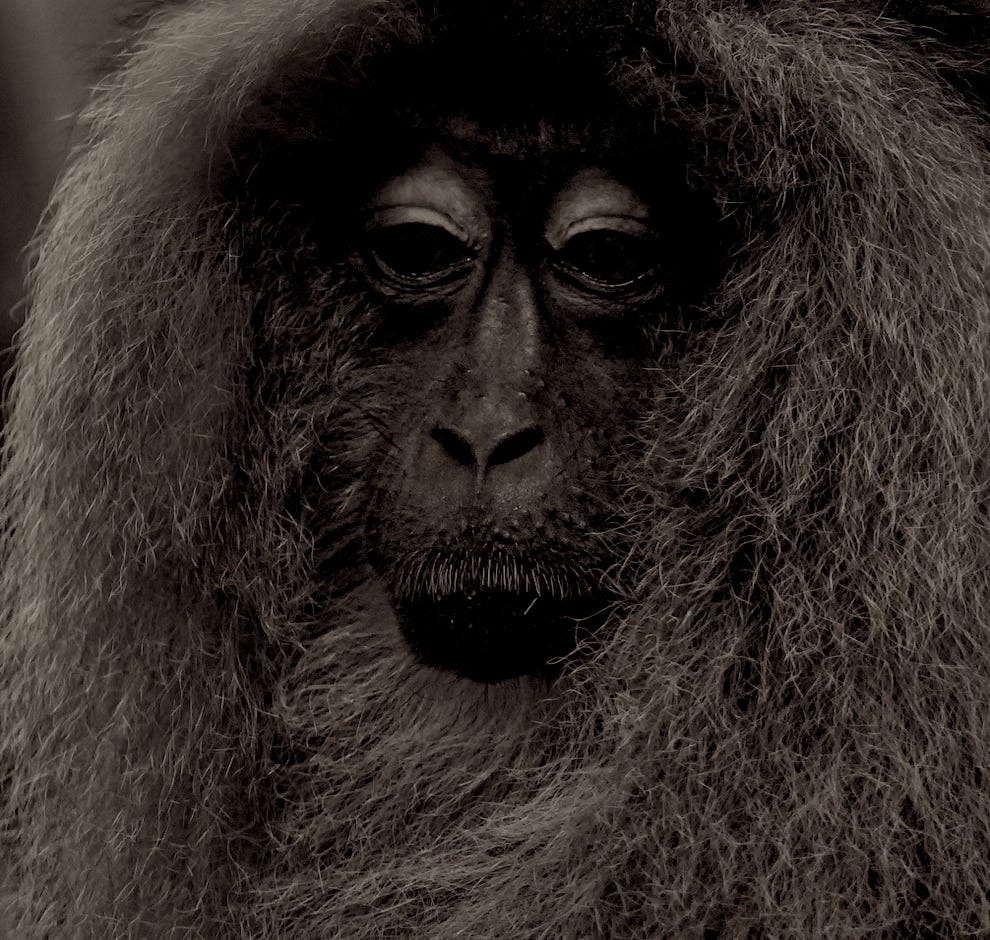
Emotions & Feelings
Or, is there a difference?

This is the third part of my current series on subjectivity, emotions and the human condition. This week I’m presenting my list of emotions.
Expressed & unexpressed
Feelings and emotions are different. Feelings are subjective – they are states of mind that only the person experiencing the feeling can sense. They are akin to the inner monologue that only you hear before your mind’s ear – your own voice. Emotions are subjective and objective, the latter case because they always have physical components which accompany them; tears, for instance, or blushing. Emotions are akin to speaking, in that you can hear your own voice when you speak, and so can anybody else within earshot.
With this distinction in mind, I’m going to give my list of emotions which evolved hundreds of thousands of years ago. To many readers, this list will seem short. It will appear that quite a few emotions have been left off the list. But bear with me…
Human emotions
1 Grief
Perhaps our deepest emotion – the one conveying the most profound knowledge – is grief, characterised by tears.
Grief is how we communicate loss. Over time, both people and things attained value in a human mind: relations, partners, trees, animals, homes, created objects. Those external things and individuals were over the years modelled with ever more sophistication during the experience of life, so that when they were lost it was necessary for our minds to communicate to themselves and to others the value of those lost people and things. Sobbing over the death of a friend imparted knowledge of great significance, of the importance of that friend to the person, and of the depth to which they were known and understood. At the same time, crying validated their mental model, authenticating it, confirming to itself and to others how important the friend was.
Crying affirmed connections felt between people. It was both an expression of such connections and an admission of their loss. As with all emotions, grief was dynamic, a reaction to the experience of reality, the mental model of a human mind in the very act of its existence. The connective properties of this emotion were enhanced by the human reaction of physical closeness during tears; by the reaching out of people for one another when weeping.
2 Fear
There were many occasions when human lives were threatened, by other people, by animals, by accidents of nature. The palaeolithic was a dangerous time to be alive. The emotion felt by human beings during such events was fear.
From the point of view of biological survival, death was the obvious danger, with injury and physical pain related issues; death and injury had to be avoided. To experience the possibility of such events, the human mind required some way of communicating to itself and to others their potential, a method of understanding what dangers were possible in the real world. That method was the emotion of fear. Fear allowed individuals to tell themselves and others that they really were in danger. Such a possibility could not be left to mere intellectual comprehension, since that could be inaccurate; so it had to be felt. An emotion, after all, is a form of motivation. It moves somebody.
Fear was the emotion with the deepest biological root. Its physical components, increased heart rate thereby bringing more oxygen and energy to the muscles, enhanced senses, a unity of the body’s muscles and nerves in preparation for flight or combat, coincided with those measures necessary for flight or combat. The physical components of fear rarely hindered action, like the tears and sobbing of grief, they usually assisted it. Thus the biological necessity of surviving in an uncertain, tumultuous world was experienced as a powerful emotion.
3 Joy
Another of the fundamental states of mind that required communication was joy, or happiness. From the point of view of a dynamic mental model of reality this was perhaps the most important human emotion, since it communicated to the self and to others the fact that the person experiencing joy was alive.
To be human and live biologically was not necessarily to live as a human being. Human beings did not know the value of being fully alive unless they told themselves, and others. This was because, since they had so few instincts and relied on their mental model of reality, there could only be mental indications of the value of life and of the sensation of being alive; noticeable indications. A dynamic, self-updating system such as the conscious human mind had to communicate this sense of aliveness. It had to experience it actively. The physical components of joy, the flushed face, sensations of bodily well-being and alertness, the tendency to laughter, ensured that the experience and thus the value and understanding of aliveness could not be missed.
Joy was our emotion of the fulfilment of human creative potential and of the experience of living. Joy could be experienced by a creator during creation, by someone experiencing nature, as one of the emotions sourced in love, and as an emotion communicating a sense of involvement with other people or with some phenomenon or event in the real world. Human beings felt joy during the process of becoming human; during the process of becoming themselves. Joy was also the emotion of the experience of freedom, since only in freedom could human beings be fully alive. Unfree, they could not be active and alive to their full potential, in which case joy could not be expressed. In the absence of joy, and through such emotions as fear and anger, and via the experience of boredom, human beings understood that they were not free.
4 Anger
When our lives did not go to plan, the universal mental state of frustration had to be expressed. The human mind had to know without doubt that some or even all of its desires were not being met, since without such knowledge it could not manage them properly. Such desires were very important, occupying a full range from selfish gratification through altruistic desires to self-growth. Frustrations applied to needs too, which might be somatic or psychological.
Anger allowed human beings to express the importance of their needs and desires; to communicate to themselves and to others the fact that these motivations were being frustrated. It could be that, denied their favourite food, they felt hindered; and if this food was considered important they communicated that fact to themselves and to others. They became angry. Or, they might see some inhumane practice being inflicted upon another, in which case they understood how this frustrated the desires of the other, and perhaps damaged the community; and so they became angry. Or, if their own growth was stunted, perhaps by inhumane social conditions, such knowledge had to be imparted to themselves and to others; so they became angry.
The physical symptoms of anger were easily recognisable: the sensation of heat at or underneath the skin, a flushed face, tension throughout the body, especially in the face, jaw, and fists; and an urge to physical action, one which might smash the obstacle and so relieve the frustration.
5 Disgust
Another basic mental state required communication when some event in the real world was considered repulsive, when it was avoided because it was felt to be unpleasant.
Primarily, this emotion was associated with food. Decaying food was dangerous, and since mere intellectual appreciation of it could not be relied upon to be consistent, some more profound way of reacting to off food was required, a reliable method of communicating to the self and to others that it was to be avoided. Over evolutionary stretches of time, this became our emotion of disgust. The prime physical symptoms were food-associated: nausea, retching of the stomach, and vomiting. These were deep-rooted reactions with distinct survival advantages, rooted in the senses of smell and taste.
Disgust, however, did expand in the minds of human beings later on to include less physical stimuli. It became a cultural metaphor. The behaviour of other human beings could induce disgust, anger too, though disgust was more an emotion of aversion, not frustration. Disgust therefore communicated to the self and to others this desire to avoid.
6 Awe
Because human beings were small, and because many of the things they encountered were huge, or in some way remarkable and wholly out of ordinary experience, a method was required for the value of such knowledge to be communicated. The mental models of reality built up by human beings did grasp their own physical situation, and so extreme situations, such as spectacular views of mountain ranges, the immensity of outer space, the intricacy of hummingbirds, or the beauty of some painting or piece of music, needed to be expressed. Such knowledge was experienced at a fundamental level, which could only be experienced and communicated by something as profound as an emotion. Our emotion in such situations was awe.
Awe – or wonder – was our emotion of juxtaposed contrasts. To confirm its model of reality, the human mind had to have some grasp of its own physical realm, but in doing so it also gained an idea of realms wholly out of possible experience. To communicate to itself and to others the vast differences experienced, an emotion, awe, evolved. Awe brought human beings together in the face of vast size, minuscule detail, or natural beauty.
The predominant physical components of awe related to breathing: a suspension, or slowing. Sometimes heart rate changed. Because of these physical signals, human minds were unable to miss the importance of what they were experiencing. Awe acknowledged the differences of these extreme experiences, at the same time authenticating the mind’s concept of normality.
Awe, like all emotions, was a cognitive phenomenon. To feel awe, some comprehension of what was being experienced was required; some mental understanding. Two people, for instance, might confront Einstein’s theory of relativity, but only the one understanding its full implications might feel awe.
7 Shame
As they lived and grew, human beings gained an ethical sense. That was based on their feeling that other human beings mattered. It was a fact of empathy, of compassion. That did mean, however, that human beings could act unethically.
It was necessary for the knowledge of unethical deeds to be experienced, since mere cerebral understanding could either be faulty or irrelevant. An emotion was therefore felt whenever a human being became aware of their own unethical act and cared about the ethical value and consequences of that act. This emotion was communicated by the colour of the face, by sensations of heat in the face, and elsewhere by general skin discomfort.
Shame was an emotion closely connected to learning, the sort of culture-specific learning impossible through thought alone. Shame was experienced after deeds. It represented empirical knowledge in a cultural framework, and therefore was often connected to spirituality or religion. Shame perfected that system of ethics built into the model of society present in every human mind. The importance of feeling shame to ethical beings – and the instability of a society without it – was marked by the extreme discomfort caused by the emotion. It could not be ignored. It was very much an emotion bringing change.
8 Embarrassment
Associated with shame was the emotion of embarrassment – a weaker version of shame. Instead of relating to ethical affairs, embarrassment tended to relate to social affairs. Like ethical affairs, social affairs were culture specific. Human beings could feel embarrassment over different things in different cultures, or not feel it at all over something embarrassing to another.
The physical symptoms of these related emotions were similar, a sensation of hot skin flushed red, especially in the face, where so much of identity and individuality was manifested. Such knowledge authenticated the model of reality that had been developed by an individual, simultaneously communicating to the self and to others that a social misdemeanour had been committed, its consequences understood. The face-centred emotion of embarrassment was both an aid to social balance and a motivation for self-improvement, since, like shame, it was not a comfortable experience. It is significant that blushing from shame or embarrassment was as good as impossible to control, even for the finest actor. This underlines the social importance of these two emotions.
9 Excitement
Endowed with a sense of time, and thus of the future and its possibilities, and because of the necessity of human beings to be involved with life, an emotion evolved with the purpose of communicating their desire for involvement.
Excitement’s physical components were flushing of the skin, a change in the delivery of speech, and general physical alertness. Through excitement, the communication of the desire for involvement in some present or future activity was communicated to the self and to others.
10 Humour
Humour is an emotion, and absolutely essential to human life, but because of its special character I will be writing about it later on in this series.
Human feelings
You may now be saying: hang on a moment, what about regret? What about guilt? What about loneliness? Those are surely emotions too.
I think it is important to be clear on the distinction between feelings and emotions (this isn’t me being pedantic). Although there are instances where that distinction is blurred – surprise for instance – in general a feeling can be distinguished from an emotion. Take guilt, for instance. Doubtless guilt has been felt by human beings for many tens of thousands of years, but it does not have an unambiguous somatic component that always wells up. Guilt is a subjective feeling. It may be strong, it may even feel overpowering, but it does not have to be physically expressed, as, say, grief does. The mode of experience of guilt and grief are different. Guilt can inspire the emotion of shame, of course, but guilt and shame are different things, as are guilt and embarrassment. Similarly, melancholy is a feeling not an emotion. Melancholy does not have to be expressed by emotion as does grief – the emotion of loss. Yes, you can express guilt and melancholy by speaking about them, but in that case there is no distinct emotion involved.
Regret and loneliness are by the same token feelings not emotions. Regret does not have an uncontrollable somatic component, as anger does, or fear, or grief. Regret can easily be communicated, but that is through language, and with non-emotional components such as deliberate sighs, or a low tone of voice. Even if such non-verbal communication is natural and isn’t suppressed, it still does not have the uncontrollable and distinct aspect that the ten emotions in my list do.
Evolution
The key, then, is that each of the emotions in the list above evolved over a very long period of time for the express purpose of dealing with a small number of fundamental human experiences, all of which gave rise to a universal emotion. It was critically important for evolving human beings to deal with loss, with frustration, with social and ethical ostracising, and so on. Such fundamental experiences became symbolised by universal states of mind.
It was critically important for evolving human beings to experience the wonder of living. That fundamental experience, that life is extraordinary and marvellous, that it matters so much, was the reason the universal emotion of joy evolved. Joy is a bit like one of those peak experiences Abraham Maslow wrote about in his influential works. Most creative people have encountered such peak experiences – being “in the flow” as some put it – and joy is the inevitable emotion that accompanies it. Joy simply wells up by itself, presenting knowledge of the full experience of life in a way that cannot be missed. This is how joy is. Such peak experiences must not be missed. The emotion must overwhelm the experiencer, otherwise it is not an emotion and the knowledge it conveys could be missed, or lost, or ignored. Such fates are not for emotions. They demand to be experienced. That is their purpose. And that is why you feel much better having experienced them – you have authenticated yourself.
The interesting question then arises: did human beings, evolving only within intensely social communities, actively participate in this entire process? Were emotions something human beings invented?
My list of fundamental experiences is both stark and profound. Loss. Social ostracising. Ethical ostracising. The wonder of life. The marvels of the future. Seeing yourself alongside the stars. Such experiences are profound regardless of culture, environment, way of life or geographical location. They are all social phenomena too. Fear and disgust are slightly different in that they have stronger biological roots, but, nonetheless, danger and bad food are stark and fundamental experiences. So I think it likely that human beings inevitably would have been encountering such experiences and discussing them, being affected by them, observing others, and living and learning – all the time. An easy and confident facility with those experiences would have been selected for by evolutionary processes, because the individuals in which they were best manifested could survive psychologically. It is all very well surviving day-to-day with enough food and shelter to manage, but if you lose your sanity because the trials of social living are too much you do not get to pass on your genes and your community suffers. The fact that I am here writing this now and you are reading it is because our ancestors in the distant past devised ways that, through processes of evolution by natural and cultural selection, allowed them to survive loss and trauma and ostracising and all the other rigours of life. Moreover, they survived in a social way – their minds survived. This therefore was achieved in the full glare of community light. It benefitted the community. And this is why I think emotions were invented. We, ourselves, over tens upon tens of thousands of years, put that suite of fundamental experiences together from which the emotions listed above developed. But, more about that next weekend.
To be continued…
Next weekend: the evolution of grief.