Holy Cow!
Or, applied narcissism.

Beltane greetings to all my followers and subscribers! This week, a couple of friends’ posts on Facebook rather got under my skin, and I realised that a book I’d been thinking about for some years really needs to be written this summer, when I should have a bit of free time. In 2006, Richard Dawkins published his book The God Delusion, which, although interesting and timely, did not exactly cover the author in glory. In 2007, Alister McGrath wrote The Dawkins Delusion, in which he gave a Christian’s riposte to Dawkins. My intention is to write (and self-publish) The McGrath Delusion, in which I take aim at both McGrath and Dawkins. Looking forward to that!
Here then, today, I present a brief article based on something that occurred to me twenty-odd years ago…
*
The concept of holy or sacred is a tricky one, because holiness is something – like certain forms of patriarchal religion – which is not supposed to be questioned, let alone dissected and given an alternative explanation. But for a long time I have wondered where this particular human invention came from.
Although we can never be sure, it seems highly likely that before the Agricultural Revolution and the arrival of the interglacial period we currently live in, no gatherer-hunter communities had any such concept as a separated holiness. Rather, they conceived of the entire natural world as something worth revering – yet not in the same way as, say, Christianity conceives reverence. Those communities were part of that natural world, inside it in a way that Christians, one step removed and with their directive from the Bible to exploit to their hearts’ content, are not. Even the period between the end of the ice age and the beginning of recorded history does not seem to have had such a concept. It is true that a community’s shaman would have been conceived of as special, with spiritual abilities for instance, but even that does not feel quite the same as holiness as we know it today, in historical times. Special, yes – even sacred, possibly. But not, I think, holy.
Patriarchal religions dominating life since around 3,000BC are the ones who consider holiness to be a critical quality. It is difficult to imagine a Siberian tribe having any use for such a concept, nor even the farmers of 5,000BC in the Fertile Crescent. Christianity, for instance, has a central concept of holy. This means there are some aspects of the religion that are simply beyond question, criticism, change or modification. What is holy in that religion are the central concepts: the truth of resurrection in the minds of believers, the area around the altar in a cathedral, the person of the man in the Vatican. Such things are beyond criticism and change. Indeed, there are concepts associated with all patriarchal religions that make sure there can be no change. Those concepts are heresy and blasphemy. The all-consuming, omnipresent tentacles of Christianity ensure through these social instruments that the holiness of the religion cannot be challenged, let alone changed.
Why is this? What exactly is holiness? Could it be real, or is it, as I suggest here, a human invention with a particular purpose?
To answer this, I need to define something that is part of the human condition. Narcissism is a universal phenomenon that, for infants and younger children, serves the vital purpose of glueing together disparate parts of a growing self during childhood, when a child is unable, through lack of life experience and understanding, to do that themselves. Narcissism typically begins to diminish around the age of nine or so, fights back during the years of adolescence, then – if the individual is lucky – fades to nothing as they grow up. Narcissism during an individual’s early years is a universal, inevitable and essential phenomenon within the human condition. It is not mere selfishness or grandiosity, it is responsible for revenge, arrogance, vanity and much, much more.
Now here’s a useful analogy. Technology is what we call applied science. Technology is the application of science. I am going to propose here a concept called applied narcissism. But what would such a concept be like?
Applied narcissism would: be utilised to separate something from the world in order to control the world; be utilised in such a way as to allow groups to believe they are entirely in the right in all matters, to the extent of never being questioned; seek to create a state of affairs in which the lives of the people it dominates are controlled not by itself, but by those people themselves through some fail-safe social mechanism; have mechanisms in place that serve to neutralise external influences; be able to continue across innumerable generations so that it never died.
Why do I use these categories? Well, applied narcissism is the way narcissistic individuals apply their credo to society, just as applied science – technology – is the way scientific individuals apply some of their credo to society. Technology built the modern world. Applied narcissism built the modern ethical world. Applied narcissism is a mode of social control used at a distance from a single centre; applied narcissism, not needing to test the real world as does science, assumes it is always correct and should never be questioned; applied narcissism encourages its victims to do their own patrolling, much as the Communists of the 20th century encouraged individuals to patrol society on their behalf, to the extent of reporting dissenters even in their own families; applied narcissism promulgates forms of behaviour that serve to eradicate independent outside influences; applied narcissism in its most intense form is always carried forward by somebody or other in an unbroken line.
These categories can be further simplified to: holiness; sacred book; blasphemy; heresy; religious continuity, eg. papacy.
My suggestion here, then, is that the patriarchal religious concept of holiness is nothing more than applied narcissism. When you or I sense that something is deemed holy, what we are sensing is not some actual paranormal force, it is the intensity of belief created by an intrinsically narcissistic structure – namely, organised patriarchal religion. The Bible is nothing more than a book the central players of Christianity do not wish to be challenged so that the text of the book is accepted worldwide without criticism. Blasphemy and heresy are forms of malign social control used by religious applied narcissism in order to stop any form of independent thought. Take heed, heretics, unbelievers and pagans!
In those days long ago when everyone in Europe was encouraged to lead ethical lives by Christianity, the concept of holiness implied moral excellence. But the diminution of religion in modern times, while an excellent development and part of humanity’s long growing up, has meant that, when no similar ethical system appeared based on the real world and not in the narcissistic desires of men, people were left with nothing to go on. No exemplars, no guidance, no hope. “Is nothing sacred any more?” as the question goes. Well, not in the Christian sense.
As it happens, the concepts of holiness and the sacred can be superseded, just as narcissism can be superseded by maturity, and religion can be superseded by an ethical system based in reality. But I think we would need new words for such concepts – I’m going to suggest wondrous and sublime.
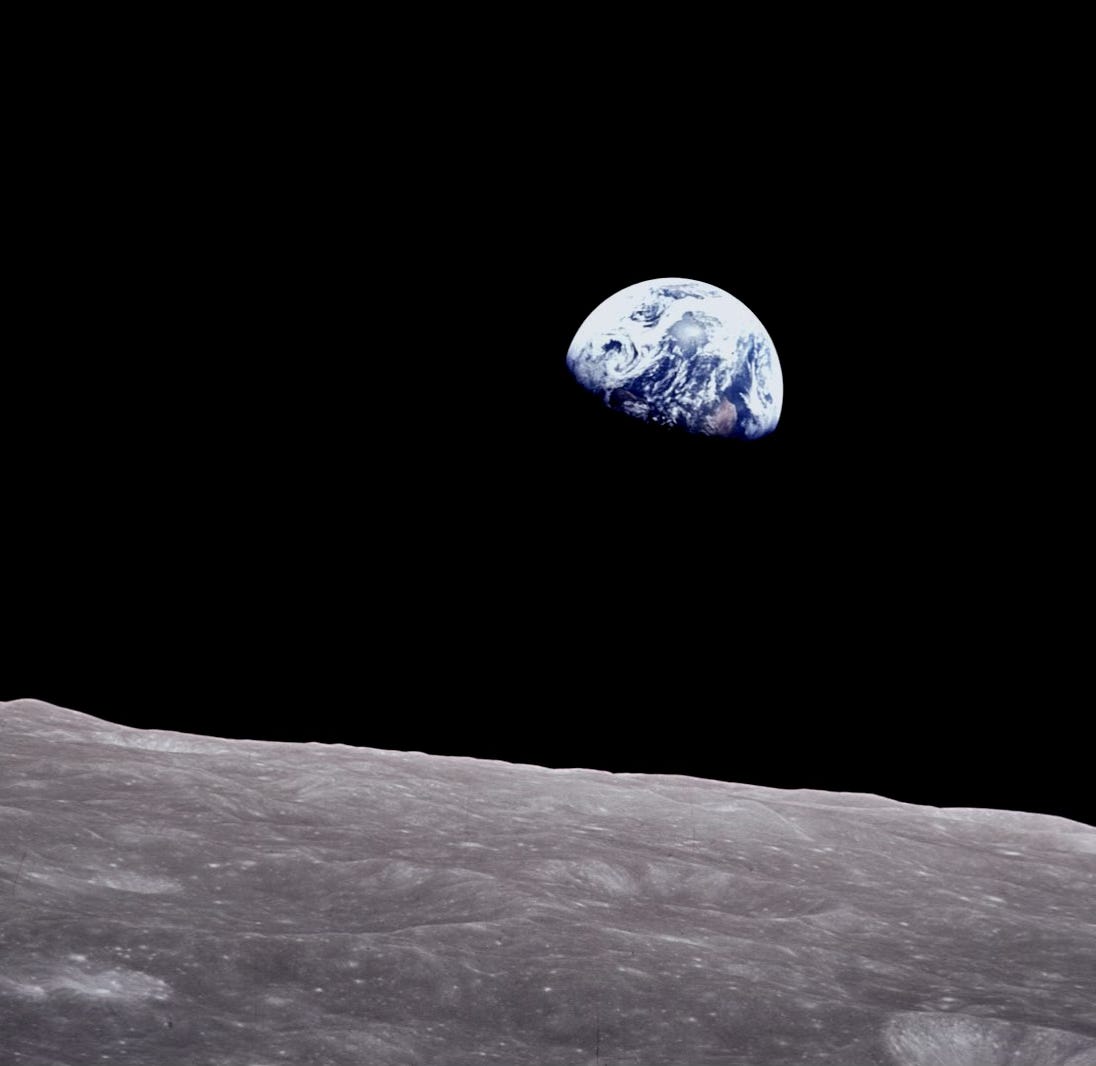
Just like our planet.