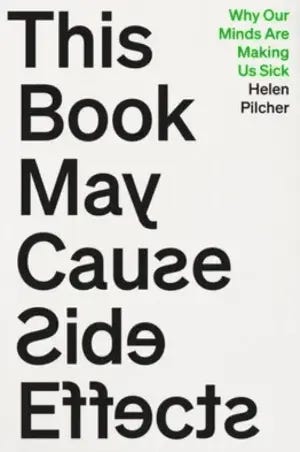
This Book May Cause Side Effects
Or, the nocebo effect.

This Book May Cause Side Effects by Dr Helen Pilcher (a highly respected science journalist and author) is an eye-opening investigation into the “bad twin” of the placebo effect. The placebo effect is the good half, in which medicine - typically a pill - is given to patients or experimental subjects on the understanding that it contains an active ingredient, whereas in fact it does not. Believing that the medicine is real, patients often exhibit remarkably positive consequences. This effect has been known for decades, and there is a lot of research into it.
The nocebo effect, as the author observes, was much less studied until recently. It is the effect in which an expectation or belief causes a negative consequence. Many scientific experiments have been undertaken recently into it, and the truth is clear. The nocebo effect is just as strong as the placebo effect.
Placebo literally means: I will please. Nocebo means: I will harm.
This book is subtitled: Why our minds are making us sick. By this, Pilcher means that the mere belief or expectation of negative side effects, or even of illness itself, is strong enough to produce real, physical effects in our bodies. The take-away of this is something few people wish to consider, which is that our minds and our bodies are one and the same thing. (Dualism is still pretty strong, alas, in religion and in hypotheses of consciousness with posit some external, universal factor.) This excellent, readable and superbly researched book is a survey of the nocebo effect and all its strange implications.
The author first summarises the anecdotal, anthropological and historical evidence for the nocebo effect, a lot of which is pretty eye-opening. There are well-documented cases of people dying because of their beliefs - not instantly, not dramatically, but because they lost all hope. Yet here Pilcher explains that the nocebo effect, like the placebo effect, is not a neutral thing. It works best in a culture in which things are simply believed. If, for example, a community believes in the malign power of witch-doctors, a curse or equivalent pronouncement is likely to be effective. Such curses in fact are pure fantasy, but if there are sufficient believers in a community the power of the nocebo effect is much amplified. The curse acquires real effects. And there are dozens more examples in this book.
Then comes the science. This is also fascinating. Human beings are creatures of the mental model, in which all of their experiences of life are set. We have virtually no instincts. If our mental models are set up to believe in the great power of medical doctors (the placebo effect) or the great power of witch-doctors (the nocebo effect), then, with corroboration from family and community, these beliefs can run our lives. And because our conscious minds and our physical bodies are one and the same thing, beliefs and expectations have real effects in the real world.
This is a really thought-provoking book. It explains so much about why people ascribe so much of their health and wellbeing to their bodies, when really they should be paying more attention to their minds, and especially their belief systems.
We are creatures of belief. Such beliefs can be based on fantasy, or they can emerge from reality. The nocebo effect is the dark side of belief. It is at once fantasy, and reality.